Black Butte Center for Railroad Culture
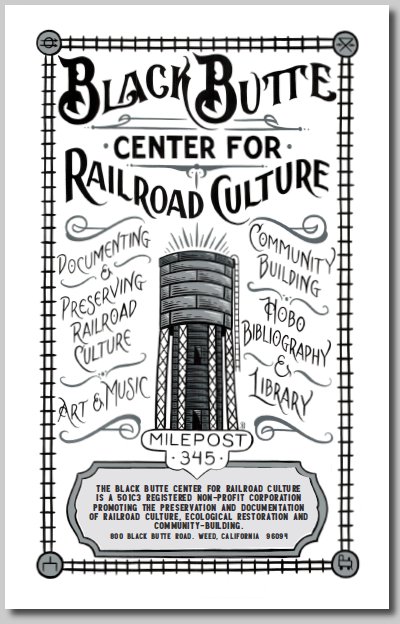
The Black Butte Center for Railroad Culture (BBCRC) preserves and promotes railroad culture by documenting and furthering the art, music, stories, community, and work of those who, historically and in modern times, travel or work on the railroads of North America.
We are based at Black Butte, a small rail junction on the outskirts of Weed, CA adjacent to the Union Pacific (ex-Southern Pacific) mainline at Milepost 345. The ex-Southern Pacific "Siskiyou Line", now operated by the Central Oregon and Pacific RR, diverges from the UP mainline at a wye just at the north end of our site. Across the tracks is the Black Butte water tank, a historic 1926 steam-era structure. We are right at the base of Mount Shasta and just two miles from the trailhead for the 6325' high Black Butte plug-dome volcano. Our site includes a large compound as well as adjacent forest and wetland areas. A major secondary focus of our project is stewardship of these forested areas where we have been engaged in long-term restoration work.
Since its establishment in 2007, the BBCRC has developed a library and resource center, where we host occasional art shows, and a music performance space, all in two historic 1920's-era boxcars. In all, eight historic railcars are on the site, including the Utah Phillips flanger car and the "Shasta" a Southern Pacific business car dating from 1888. We host regular art, music, and other shows as well as other rail-oriented gatherings. For more info on the BBCRC and our specific projects click on the links above.
The BBCRC is a volunteer-run 501(c)(3) non-profit corporation (EIN 26-1336678) run by a nine-person board of directors. Our organizational and financial documents are available to the public on request. Contact: Our USPS mailing address is 800 Black Butte Rd. Weed, California 96094. You can leave a message on our office phone at (530) 938-3856 or email us at info@bbcrc.org.